


Quietly in the wood,
It grows among the weeds;
An uncommon blossom, u tiew dohmaw,
A thing of lofty thoughts.
Quietly by shadowy streams,
To be fragrance when faded,
The joy-giving fern
Remains green for twelve moons.
Tell me twilight, beloved of the gods,
And you the motley clouds;
Tell me where is that star
That first speckles the sky.
Quietly he lives, quietly he dies,
Amidst the wilderness;
Quietly in the grave let him rest,
Beneath the green, green grass.
~ The Green Grass by U Soso Tham, Khasi poet and literary icon.
Known as the “Bard of Meghalaya” for defining modern Khasi literature.
U tiew dohmaw: a wild flower, symbol of great wisdom.
Namaste Friends,
This is the last chapter of the Meghalaya series, though I have a few more pieces burning at the back of my mind. This essay series took super long to finish and I did not, intentionally, wanted to hurry through all the lived reality of our Khasi kin. It was a massive responsibility to take up a project of narrating stories as old as time, like that of the Khasi’s. The duty of telling a people’s story through your own frame of reference without making it extractive and commoditised is one to be treated with immense care.
Here are all the chapters in sequence:
Chapter - 1
Chapter - 2
Chapter - 3
Adjacent Essay
I set foot in Meghalaya on January 2025 to find a way out of my suffocating grief of losing two of my beloved ones. I wanted a vast space to mourn, to wonder, and finally to surrender. I wanted to rest, into the strange newness of being in Shillong, that which had become too difficult for me to carry. I told my partner that I craved landscapes, waterfalls, clouds, and cold. A space for my hauntings to finally exhaust its means and merge into the infinite embrace of eternal pastels of greens and blues.
The day after my arrival in Shillong, I texted one of my Khasi friends. As we caught up on each other’s lives, she told me that she had to move to another city in the mainland for work and how deeply she misses home. I half brokered a consolation for her by saying that Shillong is unimaginably quaint, and I can truly empathize with her yearning for home. I received a sombre pause from her end, which I inferred, knowing her, reflectively looking for words. In response, I quietly wove a prayer of thanks to her ancestors for being conduits of healing to Earth. To her, I expressed gratitude for having told me many stories of her beautiful homeland.
This series has shaped me significantly, and I would be moving from this a much different person than the one who began trying to comprehend the cosmologies of Meghalaya that hid in plain sight. I wanted to know more, not in following the tailends of curiosity kind of way. I was hoping that the insights I was looking for would help me find an alternate meaning to existence and morph my inner life significantly. And I have only learned that I know nothing so far. There is a world out there of ecocosmologies that has the potential to completely change the way we relate to this sentient planet and each other. This series has been my attempt to enter into a relationship with the world that is Meghalaya, and try to be in conversation with the powerful presence of what can only be explained as archetypal and ancient.


Khasi Decolonial principle of Antidiscovery
Forestry during colonization was defined by ledger and categorization. The legitimization of land depended on operated mechanics of legibility — areas that are catalogued, mapped, measured, assessed for natural resources and biodiversity. That which is not legible to the colonizer does not exist as sovereign. Discovery then was rendering something into the economy of knowledge so it could enter the economy of extraction. They can only take what they can name. They can only name what they can enter.
Khasis forests are ruled by the forces much beyond human comprehension and protected by wardens of the land who can speak to these forces. Divinity dances on the thick roots of tradition, fear, and reverence that spread across Khasi forests like skies opening up to thunder and lightening when a renegading cyclone passes through the Bengal Delta. The outlandish stretches of oceanic canopy turning over into centuries of muted green sentience standing wordlessly still is an experience that defy both logic and words. The magic-ridden realm of Khasi forests are nature’s stern eye to the world consumed in the pursuit of extracting and accumulating. It is a cosmic mirror into something so bizarre, magnificent, and otherworldly that it would be a folly to not name them as distinct worlds.
Mysticism and mystery are the prime pillars on which the proud forest traditions of Khasis stand. These forests are completely inaccessible to the outsiders by design, and some of them are elusive even within the Khasi community. There are many reserved forests existing in Meghalaya today where no human has entered in a few thousand years. The holy grail like prevalence of mystique is so well accepted in Khasi colloquial that they take a lot of pride in the myth of no one ever having set foot within these holy locations protected by designated clans.
Khasi forestry is antidiscovery in its framework precisely because it is an active, structured refusal of legibility. They have built and maintained systems (mythological and ritual-based governance) that ensure forests cannot become accessible on colonial or capitalist terms. The mysticism is the conservation practice. Fear is a border. The sacred is a sovereign boundary beyond which every verdict is delivered by God.
Types of Forests in Meghalaya
Law Kyntang — the sacred grove, held as the dwelling place of the deity. No human activity is permitted here; it is entirely inviolable. These are some of the oldest undisturbed forest patches in the region.
Law Lyngdoh — forest associated with and protected by the lyngdoh, the traditional priest-chief. It carries ritual sanctity tied to the priestly lineage.
Law Niam — forest connected to Niam Khasi, the indigenous religion. Its protection is grounded in cosmological obligation rather than administrative rule.
Khlaw u Blei (Sacred Forest) — this overlaps in spirit with Law Kyntang but is a broader category: forest belonging to the divine, where extraction is forbidden and the boundary between the human and sacred is literally forested.
Law Shnong (Village Forest) — communally managed forest belonging to a village (shnong). Regulated use is permitted — firewood, timber, minor forest produce — under the oversight of the dorbar shnong (village council).
Law Adong (Prohibited Forest) — forest placed under temporary or permanent prohibition, often declared by the dorbar1 to allow regeneration. It functions like a managed fallow, but with traditional legal force.
Law Ri Raid (Forests of a Clan/Group of Villages) — forest held collectively by a raid, a cluster of villages sharing common ancestry or territorial jurisdiction. Governance is shared; rights are distributed but bounded.
Law Sumar — forest associated with burial grounds. The dead are interred here; this gives the forest a liminal, protective status that discourages disturbance.
Law Lum Jingte — forest on sacred hills or mountain peaks, treated as spiritually charged landscape. The high ground itself is considered sacred.
Law Kur (Clan Forest) — forest belonging to a specific kur (matrilineal clan). Since Khasi society is matrilineal, this forest passes through the female line; it is inalienable from the clan’s identity.
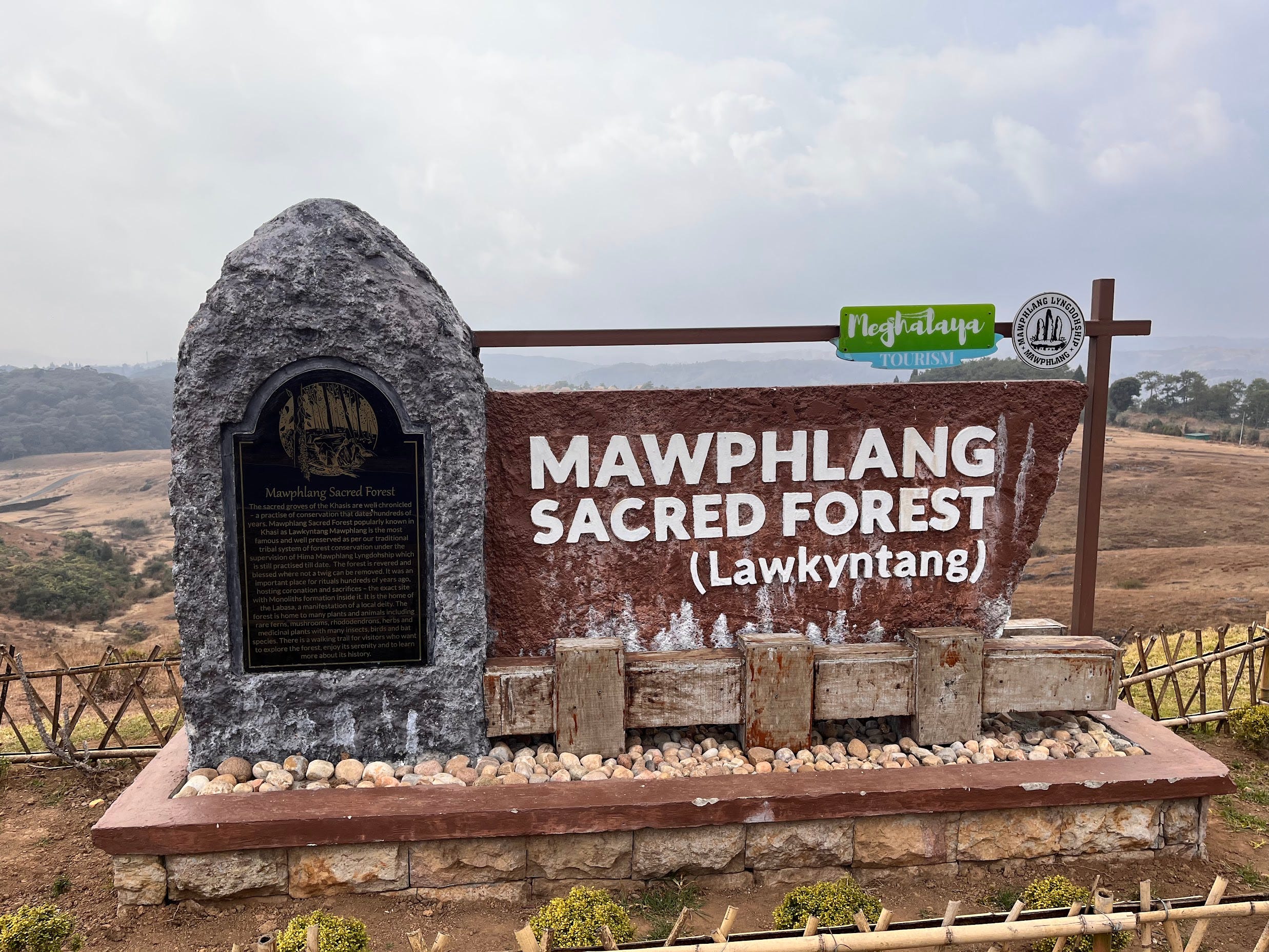
Into Law Lyndoh — Mawphlang
The simple winded uptown of Shillong is best travelled on foot, the only next best thing if speed is your priority, is a scooty. Four-wheelers are not meant for these coiling roads of steep ascent. The stairwells spread across the inner localities announce low-maintenance sustainable design. Those ghibliesque stairs are a convenient shortcut through the inner localities for those who are not afraid of exercising their cardiovascular system. The colonial charm of Upper Laban, where we found an Airbnb with a generous host, did not seem to be standing apart from the rest of the city with its Roman Catholic influence, a region that served as the seat of the Archdiocese of Shillong.
Unlike the Nilgiri ranges fencing the southern states, or the Doon Valley bordering the outer and lesser Himalayas — Meghalaya is not disjointed in its political undercurrents. Khasi heartland is united in not being a soldout to corporations and builders, irrespective of their religious affiliations. Ecospirituality is their foundational philosophy that is totally inseparable from their lived realities. I feel hopeful about this because it shows the resilience of indigenous wisdom. It reveals that no matter the changing skin of culture, the ancestral memory is the fabric that holds these landscapes and its inhabitants together in shared harmony.
On the third day, I discovered that there is a sacred grove a few miles away, that is open to visitors on a strict guided tour. However, we are allowed to tread inside the forest only for a few hundred meters. I obviously relented despite the poor bargain. We already had a rental scooty to go around the town. I was slightly apprehensive of making that one hour ride, in that bone-chilling cold of early January, on such an exceptionally light ride, but we did it anyway. Now that I think about it, that was one of the best spontaneous trips of my life.
We rode across many vibrant Khasi villages, cutting through the frost-bitten winter morning air. Those signature cottages and the morning light rushing like liquid gold through the laden orange and plum trees of their front yards. Families that owned plots near the highway had already set up their respective shops — vending tea and snacks. We spotted several matriarchs, some seemed to be octogenarians, who were running shops all by themselves — a sight only abundant in the North East India. We rode past the cascading waterfalls and foggy hills carefully, as some stretches of the highway were under-construction. We missed a few turns here and there, but finally found our way into the village of Nongrum where the wardens of this particular Lyndoh forest reside.
Our modern centralized world, so obsessed with state power structures and top-down hierarchical design, will find its worthy opponent in the highly functional grassroot institutions that conserves the Khasi forests. The Hima Mawphlang2 governance body was formed by the virtuous Blah (also known as Langblah) clan, who were the original inhabitants of Mawphlang forests. They alongside their kins of Lyngdoh (high priests) clan have been guardians of the 800-years old forest spanning over 192 acres.
The ecosystem comprises species that predate even the first Blah clan ancestors. Some trees in the forest are thousands of years old. The interiority of the forest is abundant in waterfalls and aquifers that sustain a thriving flora and fauna. Species like Rhododendron, Oak, Himalayan Yew, Kaphal, Rudraksha, are a few of the 450 species of flora proliferating across the forest floor. Himalayan mole and grey shrews tread the god-dwelling forests in peace, and also some bigger mammals like leopards, civets, and deer are said to be abundant in the belly of Mawphlang. Avians such as the rare Himalayan Bluetail and Maroon Oriole, alongside 70 other species sing and nest inside the forest canopy unperturbed.
When we reached the upper perimeter looking down at the valley, the immense upturned grasslands opening up to a dense coverage took our breath away. The cold winds swept away any ounce of scepticism about the ancient presence that rules those light-eating acres of wilderness. The dark twisted roots and branches spiralling in all directions throughout the forest felt like the innards of Gods.
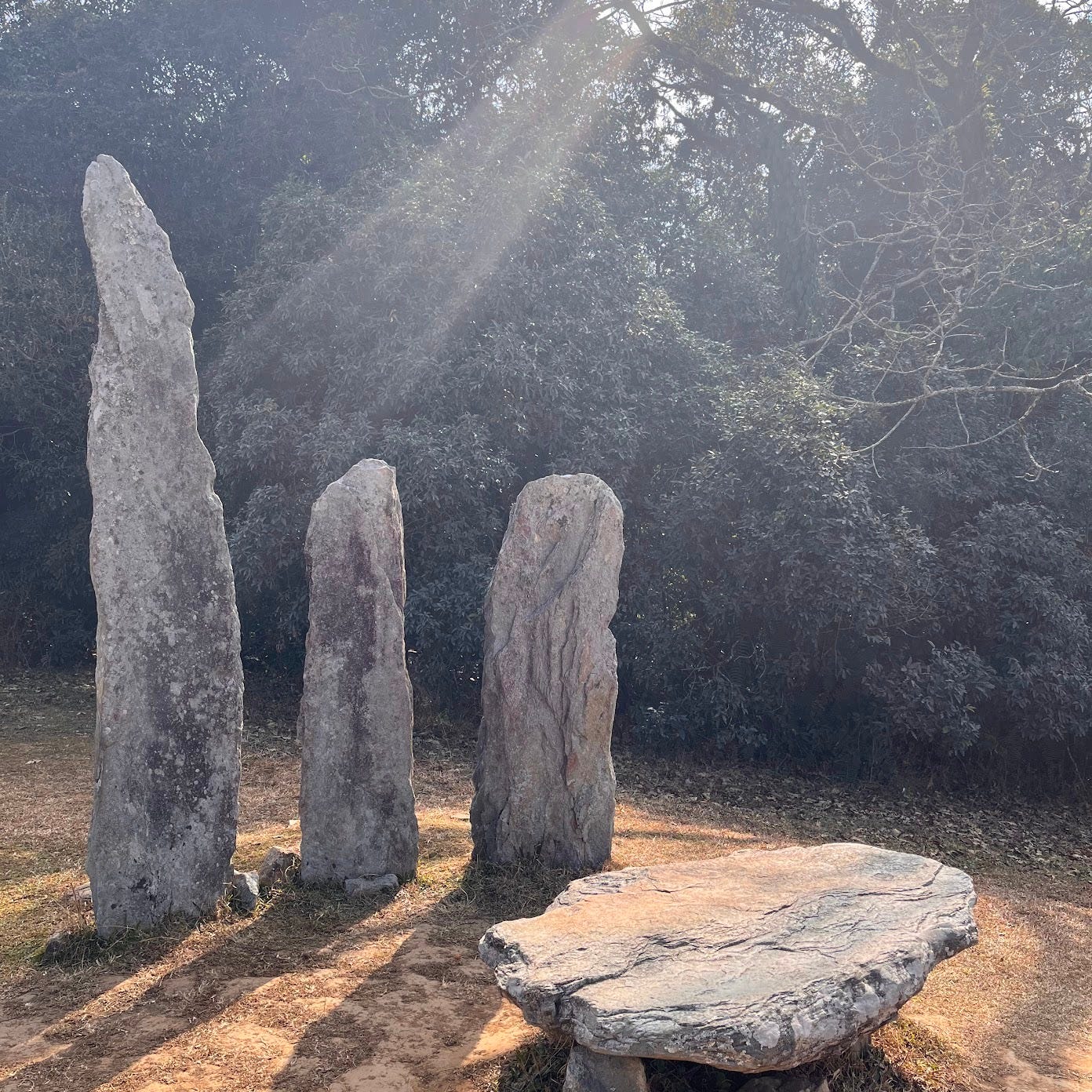
We were made to wait alongside another couple for our guide to arrive at the forest entrance. No one is allowed to enter by themselves or even in a group fewer than four people. Three upright stone slabs stood at a little distance from entrance. On walking closer, it revealed more. An eerie, almost heavy sense of foreboding clutched my heart. The erected stones did not look like tombstones, but some kind of enclosed background to another stone slab placed horizontally. Its width and thickness suggested that it is meant to be used as a seat for ceremonial purposes. It looked like a throne.


I felt a primordial presence — a fear almost spiritual in its essence was taking hold over me. I don’t know whether it was the gathering grey right above us or the massive cleared ground opening up absurdly to the dense forest that made a shiver run down my spine. I took a deep breath as I saw John, our guide, pushing a long bamboo pole to lift the uneven earth as he walked towards us. He wasn’t smiling. John made us aware that land upon which we stood were holy grounds where many sacrifices and rituals have been carried since centuries to keep the deity who protects the forest happy. “Labasa3 is our guardian, and this clearing outside of the forest where you are standing is known as Playground of the Gods, so you will do well to keep the customs of being respectful and take not even a single pebble outside of the forest grounds, lest you want to be cursed”. (Labasa is said to assume the form of a tiger or leopard to watch over the land.) I blinked and nodded as another shiver ran down my spine.
Inside the forest, tapestry of leaves and lattice of branches reach heavenwards to form a roof through which only a few golden beams touch the forest floor. Roots ancient than the history of our last few ancestors. Oh the wisdom they contain and the witness that they are of constantly turning time! I walked inside dazed with awe looking at the dry seasonal wintering phase that the trees were in. John was freewheeling his Khasi knowledge. Among many things, he told us that when trees fall and start to get consumed back into the forest they are never moved. Even if the path is obstructed by the fallen giant, people simply find a way to walk around them. He also told us that it is not customary for a Khasi to acquire or possess land in the modern sense of the word. When couples get married, land is gifted to them by the village chief or a matriarch, so that they can build a family. Land is a shared property amongst the clan, and people continue to live in good faith with each other — a centuries-old tradition. There is no concept of private property and hence ownership or inheritance. They are simply here as guardians of the land, and so will be their children after them. What is ownership to those who have the privilege of being citizens of an untaxed and clean ecosystem?
We headed back in late afternoon, which seamlessly transformed into evening within a few miles. A pale-grey mist hung around us the whole time. The cold chastised us with its rapid lashes on our bare faces. The same feeling of foreboding, of being chased made me nauseous. As if a giant metaphorical tiger trailed us unseen, as we raced against the sunset. Let me say this, and in recognition and reverence for the powers that reside in deep time — Meghalaya roads are only safe for its natives at night, because they know how to negotiate with their Gods.


Meghalaya’s forests with their deep spiritual mysticism are far removed from the urban Shillong landscapes. Mawphlang spoke to me — in its sheer scale it bared my instincts and challenged my skepticism. The lore and enigma of this living forest awakened in me an ancient fear which my body could only translate as goosebumps and uneasiness. It affirms to me that storytelling and myth making has been so far the best nature conservation tools. Making a place, a river, a forest, a mountain sacred is to broker peace with the forces that are inexplicable in their exhaustive scale. Torrid droughts, cyclones, earthquakes, wildfires, landslides, tsunamis — every unpredictable climate event that displaces human lives, have been dealt with by the people of that region in myths and stories; religions and rituals. Nature in its mythical form has dominated the realm of human imagination and evoke religious reverence for centuries. In that sense, nature has been the architecture of religion. But the true test of it is to inspire human ethics, which needs to be as transformational and timeless as the forest substrate itself — living and breathing even beneath a dried foliage.
Threshold of Another World
After a couple of days of reliving the whole memory of having visited Mawphlang and writing this essay, I had a strange dream. I was with my Khasi friends, some of them whom I never met in real life, in what resembled like a dark fantasy version of Shillong. We were supposed to pick everyone and drive to the borders. There seems to be a certain confrontation waiting for us there, the nature of which was obscured by dream logic. We were driving along those treacherously carved, typical one-sided cliff roads and a forest of tall dark pines on the other side arrested us in its perpetual gaze. When we arrived at the locality of the last pickup point for one our friends, we moved out of the car to take in the fresh air as we waited for her. Two men who were jittery and nervous throughout the trip moved a little further down the dirt path leading into the pines. When I followed them, I saw something so otherworldly, thinking of which is still giving me chills as I write this.


The men were facing each other — one facing towards me, and the other facing the first guy. A cold breeze swept through the pines, and fog descended upon us like a smoke screen. Their face slowly started to change— widening and darkening in uncanny proportions. Something so non-human about those wide-dilated eyes and thickened bush-like brows sticking out of the side of their faces. Their giant heads were square in shape and muscular, and when they spoke, a deep thunderous growl ricocheted through the empty pines. Even in their unsettling form, there was nothing malicious or threatening about this scene of possession. They spoke to one another, invoking each other’s names from their past lives and previous acts of courage and wisdom. I have recreated the scene below from memory of that dream, only the names are borrowed.
The living forest floor was abuzz a low distorted hum. The two men stood close to one another, silhouetted by the remnant light filtering through the darkening pines. The air tightened, as if it has been drawn inwards. They spoke in hushed growl like the elemental manifesting through bodies
“Lurshai.
Do not bend now.”The first man did not answer.
The second continued, voice rougher now, layered with another voice beneath it:
“You have forgotten yourself again.”
A long silence.
“Who carried your mother through the floodwater when the bridge broke?”
The first man shut his eyes.
“Who stood at Mawbynna when the others fled the hill fires?”
His breathing steadied slightly.
“You are the grandson of Rishot.
The river-watchers know your name.
The dead remember your acts of courage.”The first man suddenly looked up, now his face seemed to ease into remembrance.
He spoke slowly, as though remembering words older than himself:
“And you—Tariang, son of Mei Rynjah—who opened the path of forest to feed during the great famine—Don’t forget your wisdom now.”
The other man gave a sharp nod.
“I remember.”
Neither of them looked at me standing nearby. It was as if they had stepped somewhere else entirely.
Then the first man placed his hand against his own chest and said, almost like an invocation:
“I am not only this body.
I am the name I was given.
I am the deeds I did not abandon.”And the other answered:
“Then stand beside me now.”
I felt as if I was witnessing a ritual without a name. If I had to name it, then I would call it a ritual of resistance. My fear was totally eclipsed by awe when I woke up. Resistance—that word has its locution suspended at the threshold of this otherworld where dreams and memory walk into each other’s realms. Resistance arises from something so subtle, so unspecific that we call it intuition, but resistance is so much more. It is the result of accumulated genetic learnings and quiet knowing when things are wrong. It is an activation of that part of the psyche that tells you that it remembers the threat, it knows the lie, it can read the air like bullet points. It is ancestors awakening and borrowing your inner voice to speak to you. To protect something that has always existed quietly from breaking.
These protected forests are liminal sanctuaries to as much ancestral memory as they are to biodiversity. Khasi world, as I witnessed it for its inviolable borders, is a sacred circle of myth, memory, and matriarchy. Standing at its metaphorical doors has left me wondering about the threshold of my own ancestral inheritance. It has opened up to me a world more riddled with questions about land, legacy, and ancestral relationships to ecosystems. Memory long lost to time—ripped from the collective narrative and replaced by the more recent and painful ones of wars and migration. I wonder if my ancestors too, were beckoned by the rivers, the wetlands, the mangroves in their dreams. If they too had portals in forests through which they touched the numinous, where rituals were held daily to the psyche’s myriad archetypes. A place of surrender and healing, and a personal God to negotiate with.
I might never know all the answers, but the questions are breadcrumbs of hope that another way of life has existed quietly beneath the sedimentation of memory. I reached Meghalaya lost, bewildered, and breaking under the weight of my grief. Constantly haunted by the vapour-shaped dreams of my father. Stuck in the entrapments of responsibility and regret, my body was melting away in the liminal boundaries between dream and death. But Meghalaya’s vast ritualistic cleansing grounds, where Gods meander by day and play by night has shifted me dimensionally. By the time I left Shillong, something inside was falling into place. It felt like an erroneous compass being calibrated, a broken heart being held tight by the knowing that no matter how big a separation death, loss, and destruction — both personal and ecological—create between us and those that are taken away by time, their names, courage, love, and memory have a silent witness in nature and all its elemental forces. A witness that can never die.
Berkana is a non-stripe based reader-supported publication. Stripe does not enable independent creators from India. To encourage voices like mine that work from the margins, consider becoming my patron through Paypal.
Dorbar Khasi represents the traditional democratic and administrative system of the Khasi people in Meghalaya
Traditional Khasi state (chiefdom) in Meghalaya’s East Khasi Hills district, located about 25 km southwest of Shillong
Labasa is the supreme guardian deity of the Khasi tribe, specifically revered as the protector of the Mawphlang Sacred Forest. Local legend holds that Labasa safeguards the village from illness and famine, and punishes anyone who removes even a single leaf or stone from the grove
My heavens, Swarnali, I don't even know where to begin. Like Antonia, I am wordless.
This ending is transcendent:
"By the time I left Shillong, something inside was falling into place. It felt like an erroneous compass being calibrated, a broken heart being held tight by the knowing that no matter how big a separation death, loss, and destruction — both personal and ecological—create between us and those that are taken away by time, their names, courage, love, and memory have a silent witness in nature and all its elemental forces. A witness that can never die."
It's clear your time in Meghalaya and the deep forests was the medicine your soul needed... and you conveyed this story in a way that makes it clear these Indigenous places and people are the medicine our world needs right now.
So much of what you described reminds me of the way my sovereign neighbors in the Pueblos of Northern New Mexico -- San Ildefonso, K'ha p'o Owingeh, Ohkay Owingeh, and more -- tend to and protect the high deserts and mountains of our area. Certain places are off limits to non Pueblo people, I will never set foot on those places, and that is a good thing. Rituals take place, some of which are open to us, some of which are not. The lifeways and practice and and relationaltivity to the earth go back to "time immemorial," as they say.
"Civilization" and colonization and capitalism have killed so much, have attempted to extract and sell the essence of everything. But the essence cannot be lost, as you remind us. I bow in deep gratitude to the Khasi people for their unwavering protection of these forests, and to you for bringing this story medicine to us.
I am ... wordless. Changed by this. Or reminded. This entire journey -- all I can say is thank you. I have no doubt that your ancestors had beckonings and portals. Even in a life that has been orphaned from that connection, I don't believe it is ever entirely lost. I have had some conversations with Earth and Water where I live ...
And oh my goodness, THAT POEM.
(I want an emoji like that heart-on-fire emoji but a heart-in-water emoji 🩵)